
Scientific Presentation – Poster L22
Bioavailability and Stability of Epinephrine Nasal Powder Formulations for Treatment of Anaphylaxis
Background
With prompt administration, epinephrine is an effective life-saving treatment of anaphylactic shock. Current needle-based autoinjectors available for self- and caregiver use present hurdles for effective use, including:
- Needle-based drug delivery may deter or delay use by lay people
- Aqueous epinephrine formulations are inherently unstable. Restrictive handling and storage conditions may limit availability or compromise efficacy
Orexo is developing OX640, an epinephrine nasal powder for treatment of anaphylaxis in a community setting.
OX640 is a spray-dried, preservative-free rapidly dissolving, composite amorphous nasal powder, designed with a particle size distribution for optimal deposition on the nasal mucosa. The powder is pre-filled into an easy-to-use, single-dose administration device (Aptar UDS®), operating in a similar way to liquid nasal sprays. A custom-designed, portable protective storage tube has been developed, to provide protection from moisture and mechanical stress.
Pharmacokinetics and pharmacodynamic response as well as stability of initial OX640 formulations is described.
Methods
An open-label, 5-treatment, cross-over study was conducted in 40 healthy volunteers, comparing four development formulations of OX640, 1 mg (OX640-1, to OX640-4), to EpiPen 0.3 mg.
Each subject received all study medications in a randomized order with a wash-out period of 24h between doses. Plasma levels and cardiovascular response (heart rate and blood pressure) were followed for 6h. Pharmacokinetic parameters were determined by noncompartmental analysis. Relative exposure between OX640 and EpiPen were estimated as geometric mean ratios with 90% confidence intervals.
12-month stability data of the tested formulations and under accelerated conditions (40°C, 75% RH) is presented, including epinephrine content (assay/potency), epinephrine degradation products (related substances) and enantiomeric purity, with 6 month data in 50°C available for one nasal formulation.
Results
Pharmacokinetics
- Epinephrine was well-absorbed from all formulations
- EpiPen displayed the most rapid initial peak, with OX640 formulations catching up within 10 min. AUC over the first 20 min was comparable between nasal treatments and EpiPen
- Of the OX640 formulations, OX640-3 and -4 displayed more rapid absorption
Figure 1:
Epinephrine plasma profiles (Geometric mean). Plasma levels not baseline adjusted.

Table 1
Epinephrine PK parameters
| Parameter [unit] | OX640-1 1 mg |
OX640-2 1 mg |
OX640-3 1 mg |
OX640-4 1 mg |
EpiPen 0.3 mg |
|---|---|---|---|---|---|
| AUC0–t [h·pg/mL] | 499 (48.0) | 598 (57.1) | 590 (49.5) | 573 (57.0) | 417 (41.7) |
| Cmax [pg/mL] | 289 (75.8) | 327 (88.2) | 396 (69.2) | 382 (92.0) | 344 (64.2) |
| Tmaxa [min] | 20 (6, 90) | 25 (6, 91) | 20 (6, 150) | 20 (6, 60) | 8 (1, 239) |
| t1/2 [min] | 66.7 (48.3) | 70.2 (54.8) | 67.7 (46.0) | 82.1 (70.8) | 86.0 (82.1) |
| AUC0–20minb [h·pg/mL] | 46.5 (98.7) | 49.7 (94.9) | 63.9 (84.4) | 63.8 (95.6) | 54.2 (63.7) |
Geometric mean (CV%); a) Median (min, max)
Exposure parameters not baseline adjusted
Table 2
Exposure parameter comparisons vs EpiPen
| Formulation | AUC0–t | Cmax | AUC0–20min |
|---|---|---|---|
| OX640-1, 1 mg | 123.0 (106.6-141.9) | 86.2 (68.3-108.7) | 87.8 (68.3-112.7) |
| OX640-2, 1 mg | 147.5 (128.1-170.0) | 98.9 (78.5-124.7) | 94.5 (73.7-121.3) |
| OX640-3, 1 mg | 142.9 (124.1-164.5) | 116.5 (92.6-146.6) | 117.5 (91.7-150.5) |
| OX640-4, 1 mg | 137.0 (119.1-157.6) | 112.2 (89.2-141.1) | 118.2 (92.4-151.4) |
Geometric mean ratios (90% CI) vs EpiPen, 0.3 mg [%]
Exposure parameters not baseline adjusted in this analysis
Pharmacodynamics
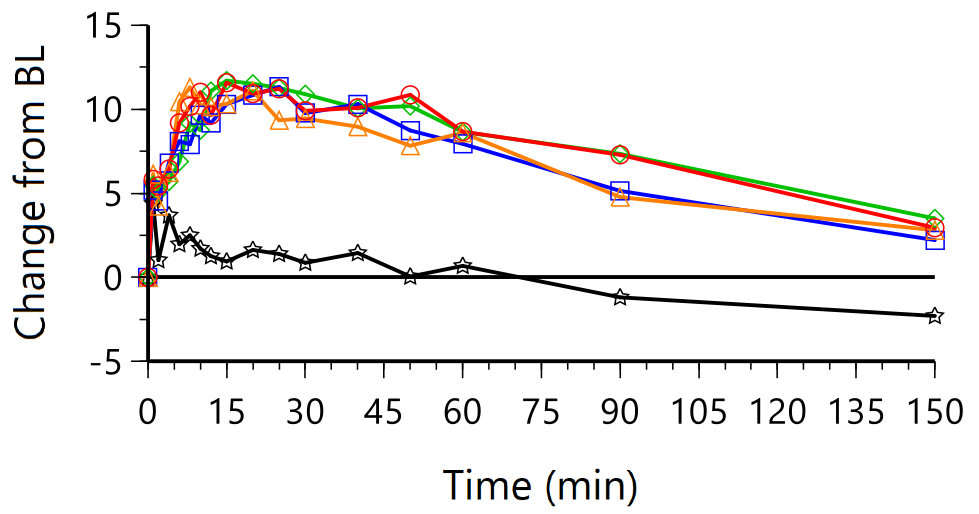
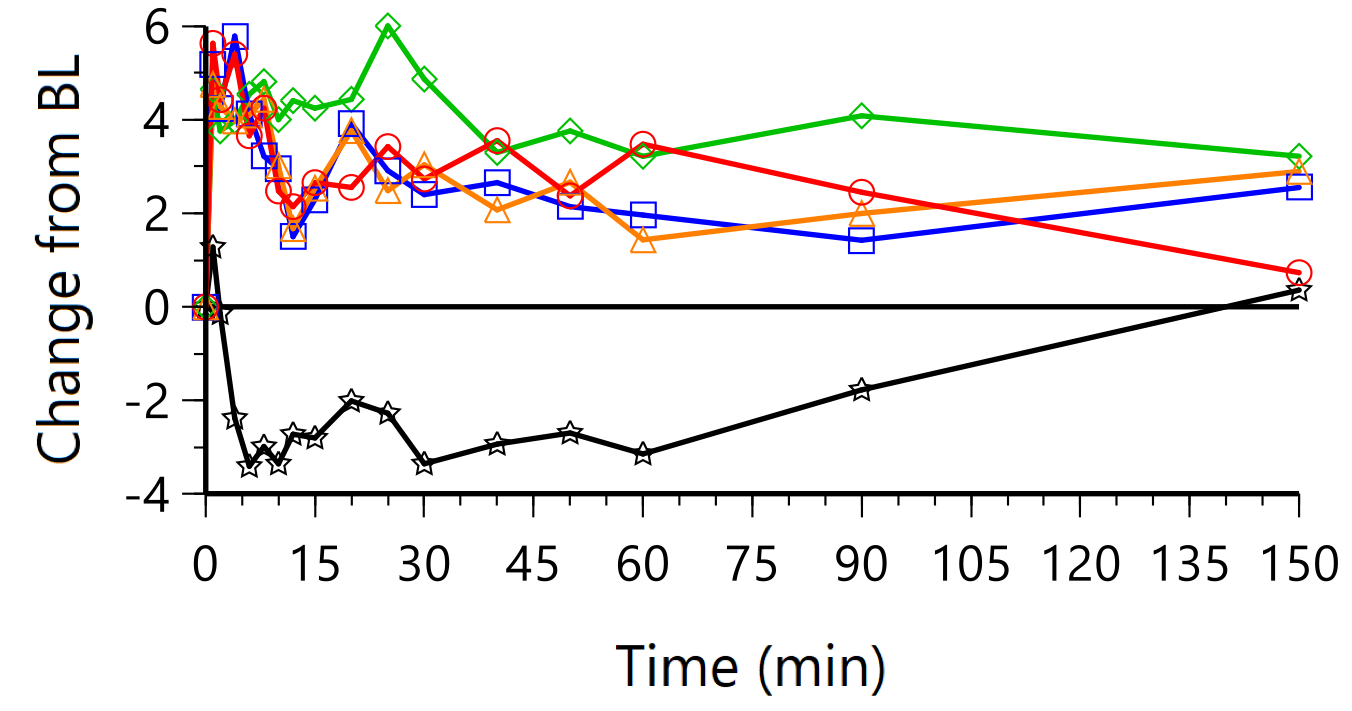
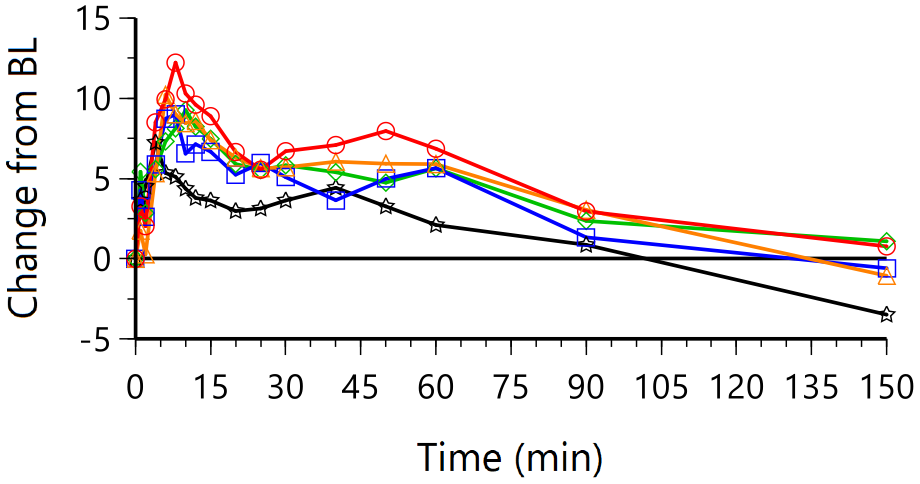
- Systolic and diastolic blood pressure increased in proportion to systemic exposure following OX640 nasal formulations
- EpiPen elicited a lower mean effect on systolic blood pressure than nasal formulations and an average decrease in diastolic blood pressure
- All treatments elicited comparable increases in heart rate
Safety
- EpiPen and OX640 formulations demonstrated typical sympathomimetic systemic side effects, including headache, palpitations, tremor, hypoesthesia and hypervigilance
- One subject was discontinued due to reoccurring ECG changes after dosing (prolonged QRS complex)
- Most subjects reported mild discomfort in connection with nasal dosing, typically transient nasal stinging/burning
- 34% of subjects reported injection site pain following EpiPen administration
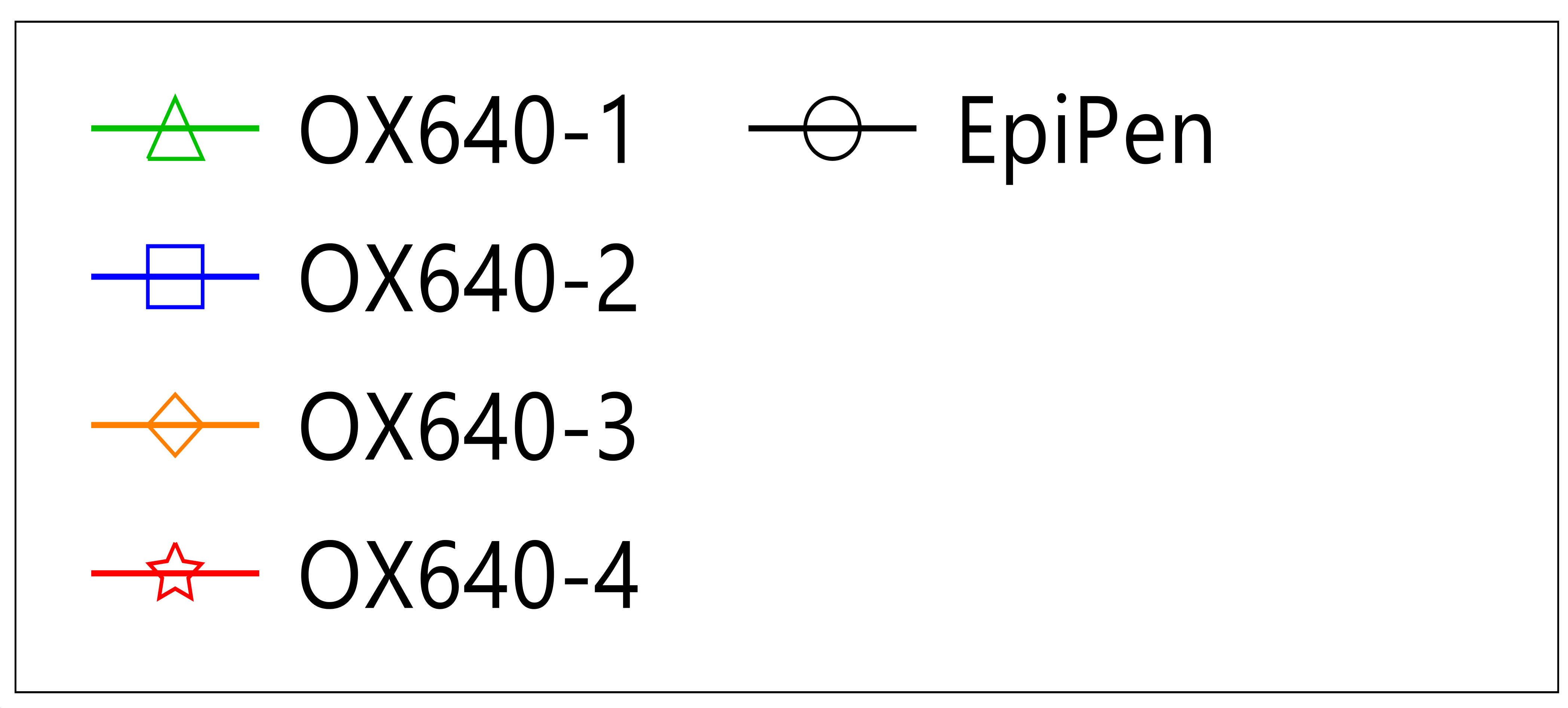
Figure 2: Pharmacodynamic effects
Formulation stability
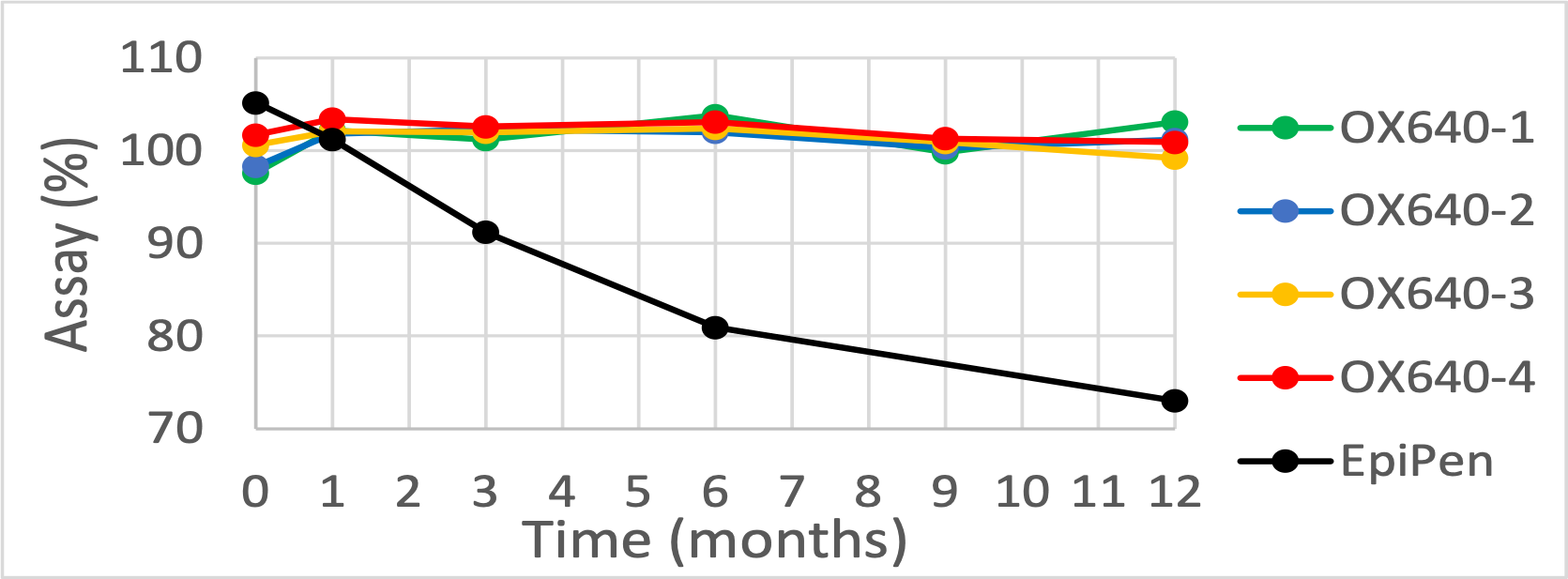
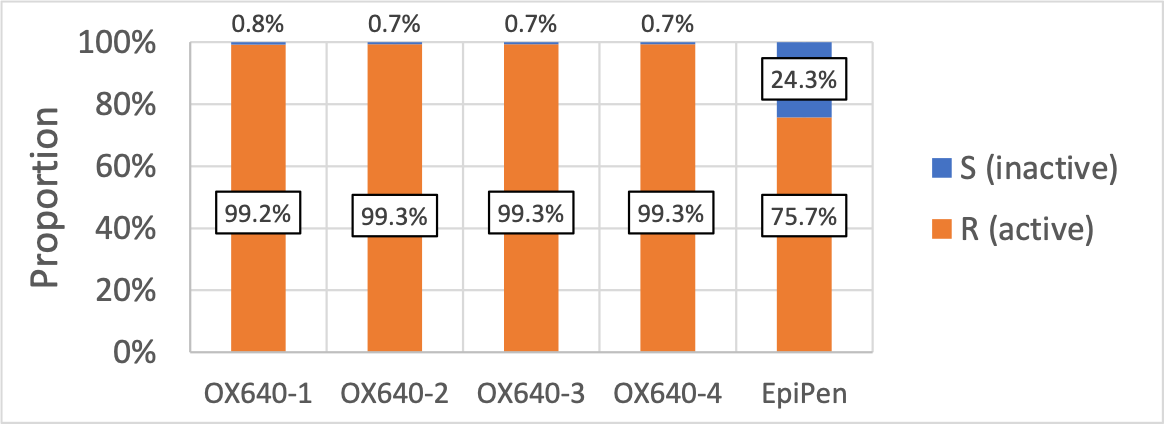
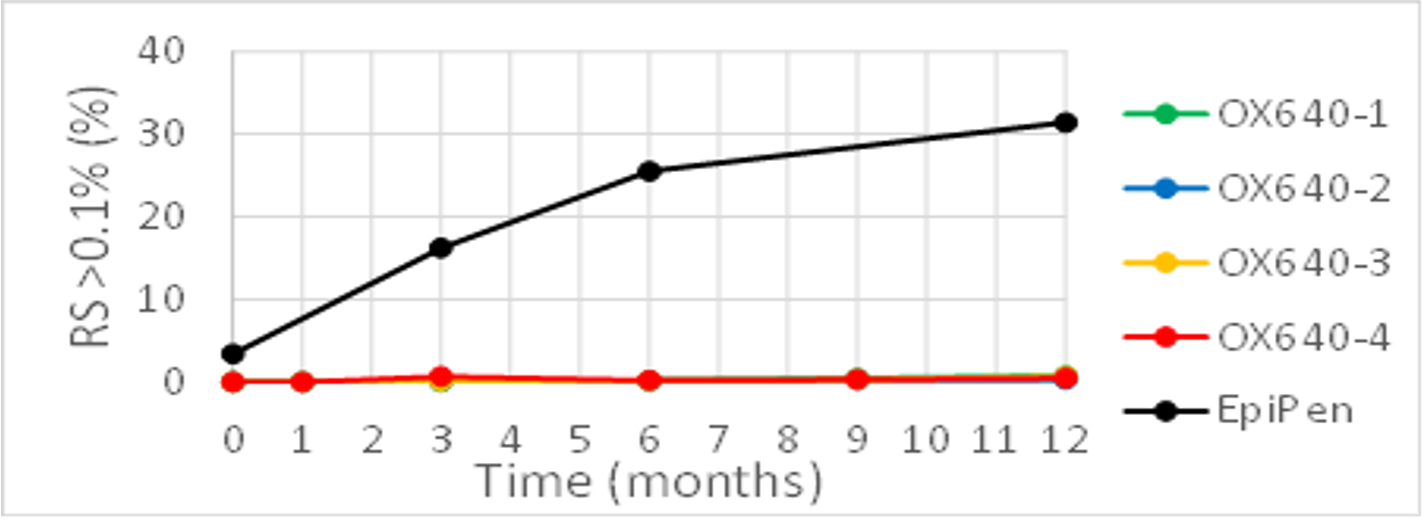
- The EpiPen formulation was rapidly degraded under accelerated storage conditions. An assay result of 73% with an enantiomeric purity of 76% suggests only 55% of the nominal dose remaining at 12 months. Detected degradation products (31.4%) corresponded well with assay results.
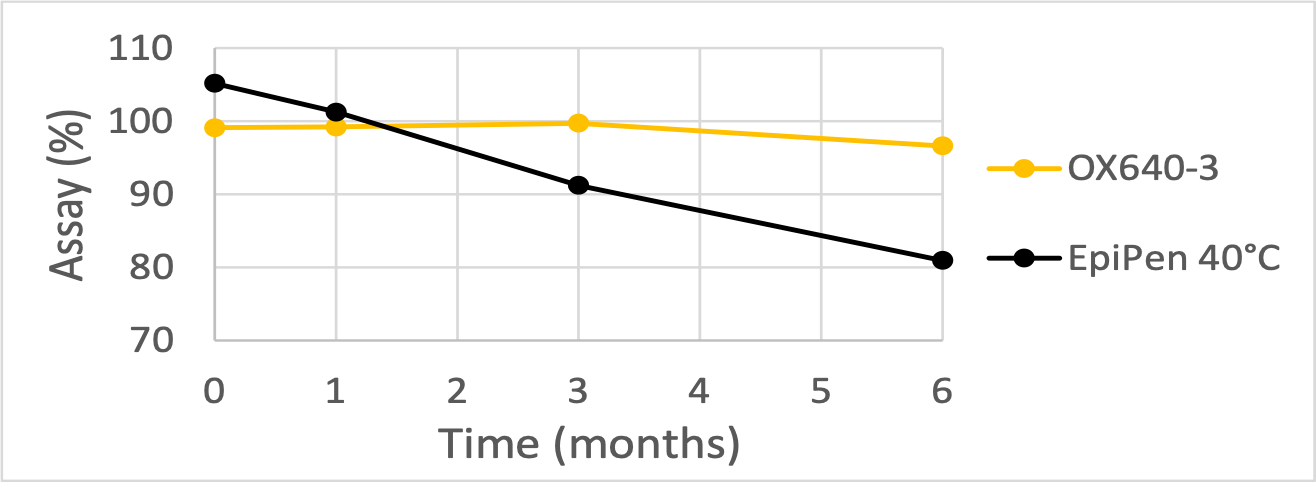
- OX640 formulations were stable maintaining the full nominal epinephrine content (99-103%) with maintained enantiomeric purity (>99%) over 12 month, and had less than 3% degradation over 6 months in 50°C.
Figure 3: Epinephrine stability
Conclusions
- OX640 displayed comparable or slightly higher total systemic exposure than the EpiPen reference product
- Initial exposure from OX640 formulations appears to be within the clinical range of EpiPen and IM administration with a manual syringe (literature data)1
- Mean effects on blood pressure and heart rate were comparable or higher from OX640 than from EpiPen throughout the testing period, supporting adequate clinical effects.
- OX640 formulations were well tolerated.
- Superior stability of OX640 under accelerated conditions supports maintained efficacy after carrying it in the field
- Overall, results support feasibility and continued development of OX640 for treatment of anaphylaxis
Funding
This work was fully funded by Orexo AB.
1) FDA Briefing Document, Pulmonary-Allergy Drug Advisory Committee Meeting, May 11, 2023
Presented at the 2024 AAAAI Annual Meeting, Washington DC, Feb 23-26, 2024

Robert Rönn
PhD, Senior Vice President Head of R&D
robert.ronn@orexo.com
+46 (0) 18 780 88 00

Jonas Sävmarker
PhD Scientific Director R&D
jonas.savmarker@orexo.com
+46 (0) 70 537 75 77
Meet Orexo at the following scientific conferences
Sep. 16 -17, 2026 IPAC-RS 2026 Nasal Innovation Forum


