
Scientific Presentation – T1330
Amorphous Powder for Nasal Delivery:
Intranasal Naloxone Powder for Treating Opioid Overdose.
Purpose
The nasal route of administration has several benefits for systemic drug delivery, including non-invasive dosing, rapid absorption, and no first-pass metabolism. However, liquid nasal sprays have some limitations, e.g:
- Poor chemical stability in aqueous solutions
- Requirement for good solubility of the API
- Suboptimal and variable absorption due to swallowing
We explored the possibility of developing a rapidly dissolving, spray-dried nasal powder formulation to overcome the limitations of liquid formulations while maintaining the advantages of the nasal route of administration.
Objectives
- Development and characterization of spray-dried nasal powder formulations of naloxone compared with a commercially available liquid nasal spray
- Comparison of pharmacokinetic properties of novel powder formulations with the liquid nasal spray
Methods
Four compositions (A, B, C, and D; see Table 1), all presented as amorphous solid dispersions (ASD) of naloxone in combination with various excipients, were spray-dried. The powders were characterized using laser diffraction, XRPD, and HPLC. Stability was monitored for 12 months under long-term conditions (25°C/60% RH) and for 6 months under accelerated conditions (40°C/75% RH).
Pharmacokinetics of the novel powder formulations, administered as a single dose using an Aptar UDS powder device, were compared with a commercially available liquid nasal spray (Narcan®) in a five-period crossover bioavailability study in healthy volunteers (n=20).
Results
Figure 1: Naloxone Plasma Concentration vs. Time
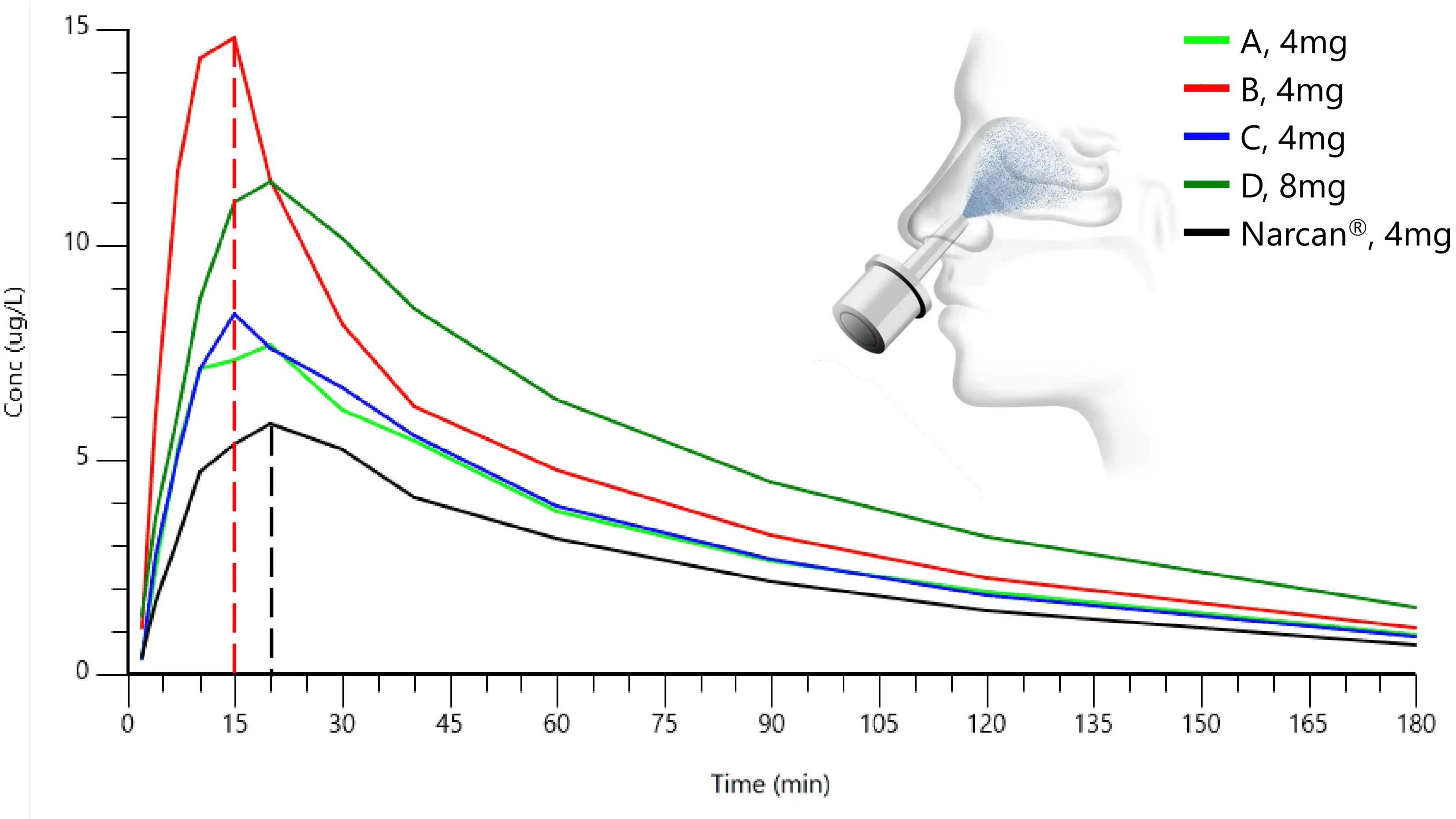
Comparative Bioavailability of Powder Formulations vs. Liquid Nasal Spray
- Nasal powders showed significantly higher plasma concentrations of naloxone, a longer duration of elevated plasma levels, and more rapid absorption compared with Narcan®
- Formulation B (containing sucrose laurate) demonstrated the highest bioavailability and the most rapid absorption, with approximately 84% higher total exposure and 175% higher peak exposure compared with Narcan®
- All formulations were well tolerated
Powder Characterization and Stability
- Spray drying produced free-flowing powders with a narrow particle size distribution suitable for nasal administration
- All four compositions were chemically stable under both long-term and accelerated conditions, with related substances below 0.3% at study completion
- All formulations remained physically stable and retained their amorphous state throughout the stability studies
Table 2: Physicochemical and Stability Data (Total Related Substances Shown)
| Composition | Dv,10 (µm) | Dv,90 (µm) | Fines %, <5µm | XRPD | 12M 25/60 (%RS) | 6M 40/75 (%RS) |
|---|---|---|---|---|---|---|
| A | 15 | 44 | 0 | amorphous | 0.11 | 0.10 |
| B | 15 | 55 | 0 | amorphous | 0.19 | 0.19 |
| C | 17 | 57 | 0 | amorphous | 0.14 | 0.28 |
| D | 17 | 58 | 0 | amorphous | 0.08 | 0.08 |
Table 3: Pharmacokinetic Parameters (Average Values, n=20, Geo.CV%)
| PK Parameters | A | B | C | D | Narcan® |
|---|---|---|---|---|---|
| AUCt (h*ng/ml) | 10.7 (24.8) | 14.7 (18.5) | 10.9 (27.6) | 16.9 (35.9) | 7.99 (44.1) |
| AUCinf (h*ng/ml) | 10.8 (25.3) | 14.8 (18.6) | 11.1 (28.7) | 17.1 (35.9) | 8.06 (44.6) |
| Cmax (ng/ml) | 8.43 (44.2) | 15.6 (46.5) | 8.94 (35.4) | 12.1 (45.4) | 5.67 (55.8) |
| Tmax (min) | 20 (6.5, 40) | 15 (7, 30) | 15 (7, 30) | 20 (10, 40) | 20 (7, 30) |
| T½ (min) | 74.6 (30.0) | 76.1 (22.8) | 88.3 (43.6) | 85.5 (20.0) | 84.2 (23.2) |
Conclusions
-
Amorphous spray-dried naloxone nasal powders with appropriate particle size distribution for nasal delivery were successfully developed, with limited risk of lung exposure
-
All powders demonstrated excellent chemical and physical stability, even after 6 months under accelerated conditions (40°C/75% RH)
-
Naloxone nasal powders showed improved systemic absorption and reduced variability compared with a commercially available liquid nasal spray

Jonas Sävmarker
PhD Scientific Director R&D
jonas.savmarker@orexo.com
+46 (0) 70 537 75 77

Robert Rönn
PhD, Senior Vice President Head of R&D
robert.ronn@orexo.com
+46 (0) 18 780 88 00
Meet Orexo at the following scientific conferences
Sep. 16 -17, 2026 IPAC-RS 2026 Nasal Innovation Forum


